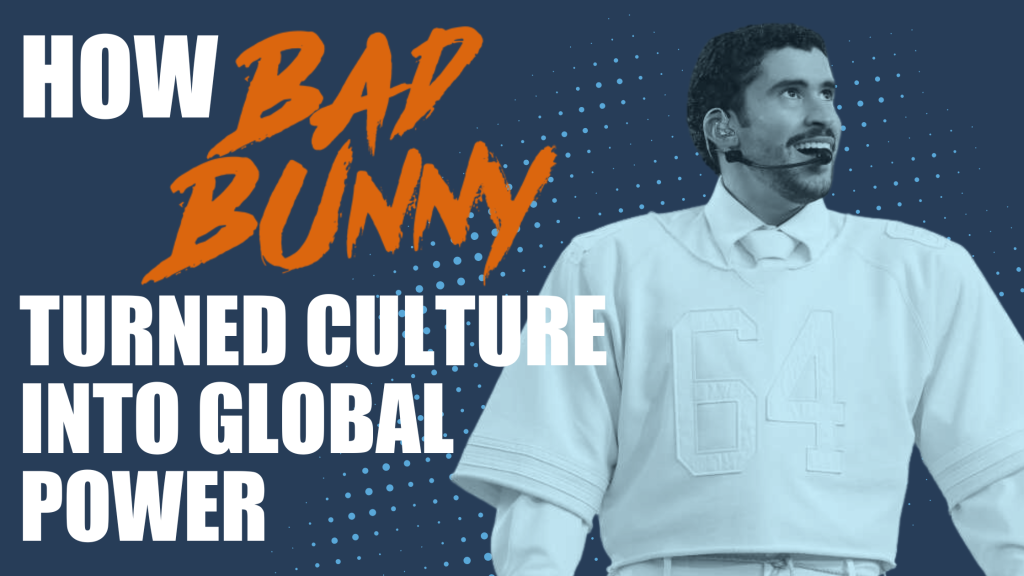
Authenticity and nostalgia are at the core of Bad Bunny’s brand image, and those themes carried the Puerto Rican music artist all the way to the 2026 Super Bowl halftime show.
Ever since his song “Diles” caught the attention of Hear This Music record label in 2016, Bad Bunny has grown exponentially in popularity. He has received six Grammy awards, including three Grammys at the most recent ceremony on Feb. 1, and 18 Latin Grammy awards.
He sings almost exclusively in Spanish, positioning himself as an authentic representative of Puerto Rican and Latinx culture overall. Most notably, his 2025 residency in Puerto Rico, lasting over two months, demonstrated his commitment to honoring the archipelago and culture that inspire much of his artistry. Titled “No Me Quiero Ir de Aquí,” the residency boosted tourism by raising almost $200 million for the local economy. Earlier show dates were reserved for residents, establishing a strong emotional connection that’s key to any marketing strategy. Therefore, rather than a spectacle for outsiders, the arena residency became a celebration of Bad Bunny’s home country.
Bad Bunny also excluded the United States from his most recent global tour, so the fact that he accepted a performance during the Super Bowl was surprising to many fans. He has been consistently outspoken against the United States Immigration and Customs Enforcement (ICE) and its recent violence toward people suspected of being undocumented immigrants. When he accepted one of his Grammys this year, he addressed those sentiments directly, saying, “We’re not savage. We’re not animals. We’re not aliens. We are humans, and we are Americans.”
Though many celebrities tend to avoid being purposely controversial, Bad Bunny has embraced
using his platform to speak on issues he cares deeply about. He reportedly received death threats
from people who denounced the halftime performance decision, with many claiming that it
would not be “American” enough. A petition to replace Bad Bunny with another artist got
120,000 signatures, and Turning Point USA even sponsored a separate halftime show.
Regarding other minor controversies, his fashion choices also flaunt traditional gender norms
and the status quo for Latin American culture. He has worn heavy makeup, skirts and in his
video for “Yo Perreo Sola,” full drag. In an interview with GQ magazine, he said, “To me, a
dress is a dress. If I wear a dress, would it stop being a woman’s dress? Or vice versa?” He
recognized that the reggaeton genre is very macho, so his contradictory fashion choices
encourage self-expression among his audience.
Social media users have also described Bad Bunny’s motifs as boring; for example, the cover of
“Debí Tirar Más Fotos” has two monobloc chairs. At face value, it is very simple, but that’s
precisely the point. For many Latin American audiences and immigrant communities, this
specific type of chair is instantly recognizable as an object inextricably tied to their childhood,
where family members would eat, gossip and build fellowship with one another. By tapping into
the bittersweetness of nostalgia, Bad Bunny furthers his emotional tie with listeners.
Last Sunday, Bad Bunny’s Super Bowl halftime show was centered around nostalgia, unity and
love, and it was a showcase of vibrant Latinx culture. It included traditional instruments, an
on-stage wedding and a detailed block party atmosphere, among other components. At the very
end, he proceeded to name every country in South, Central, and North America as the words,
“The only thing more powerful than hate is love,” flashed behind him. This message effectively
transformed the Super Bowl stage into a cultural and political statement, highlighting the
importance of overcoming perceived differences.
Bad Bunny’s self-marketing is a masterclass in how pure authenticity and cultural roots can be
powerful tools. Even in the midst of accelerating global renown, Bad Bunny has always
maintained his empathy toward others less fortunate than him and steeped his brand in Puerto
Rican pride. He’s shown that staying true to one’s culture will not limit fame, but rather expand
reach and unite millions of people under cohesive, positive messages.